What Is High-Frequency Jet Ventilation? A Guide to HFJV for Surgical and Critical Care Teams
High-frequency jet ventilation (HFJV) keeps patients oxygenated with small, rapid pulses of gas delivered through a narrow catheter or jet port, often while the airway stays open for the surgeon. It solves a problem conventional ventilators can't: how to ventilate a patient when the airway itself is the operating field, or when lung and chest movement needs to stay nearly still.
For anesthesia, respiratory therapy and biomedical teams, HFJV can look like a niche technology. In practice it's an everyday tool in ENT, thoracic and electrophysiology suites. This guide explains how jet ventilation works, how it compares with other ventilation modes, where it's used, and what to look for when you buy or service a jet ventilator.
Key takeaways
- HFJV delivers very small breaths at rates far above normal breathing, typically 60 to 600per minute, and exhalation happens passively.
- It gives surgeons an open, unobstructed airway and reduces chest and lung movement during delicate procedures.
- HFJV is not the same as high-frequency oscillatory ventilation (HFOV); the two work differently and are used in different settings.
- Safe HFJV depends on heated humidification, pressure monitoring with automatic cut-off, and a clear path for exhaled gas.
How does high-frequency jet ventilation work?
A jet ventilator takes gas from a high-pressure air and oxygen supply and releases it in short, controlled pulses through a small-bore catheter, a jet port on an endotracheal tube, or a jet-capable laryngoscope or bronchoscope. Each pulse is small, roughly 1 to 3 mL per kilogram, often close to or below the volume of the patient's anatomic dead space. Because pulses come so quickly (about 1 to 10 per second), gas still reaches the alveoli through a mix of bulk flow, turbulent mixing and enhanced diffusion.
Exhalation is passive. The lungs and chest wall recoil and gas leaves around the catheter and out of the open airway. That's why an unobstructed exit path is the single most important safety condition in jet ventilation.
Clinicians control HFJV with a handful of settings:
- Driving pressure: the pressure behind each pulse, the main factor in how much gas is delivered.
- Frequency: pulses per minute.
- Inspiratory time: the share of each cycle spent delivering gas, usually 20 to 60 percent.
- FiO₂: the oxygen concentration of the jet gas, from 21 to 100 percent.
- Pressure limits: pause pressure and peak pressure alarms that stop the jet automatically if pressure builds up in the airway.
Single jet vs. double (superimposed) jet. Some systems add a second, low-frequency jet running at roughly 12 to 20 breaths per minute on top of the high-frequency pulses. This superimposed technique helps clear carbon dioxide and support oxygenation during longer cases.
Why humidification matters. Jet gas comes from dry medical gas supplies at high flow.Without heating and humidification, it can dry and injure the airway lining, which limits how long jet ventilation can run safely. Integrated heated humidification is one of the biggest differences between modern jet ventilators and older or manual jet injectors.
HFJV vs. HFOV vs. conventional ventilation?
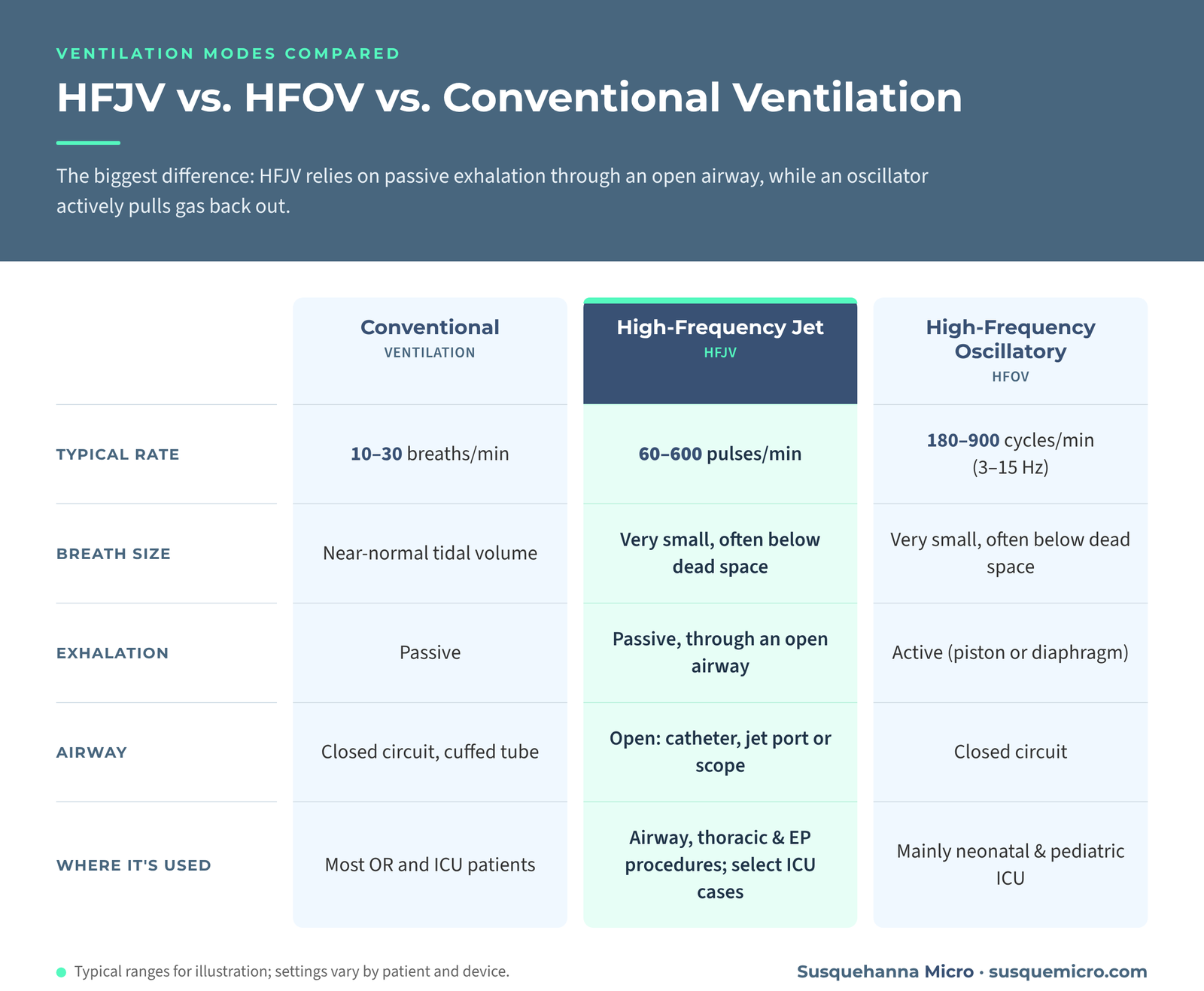
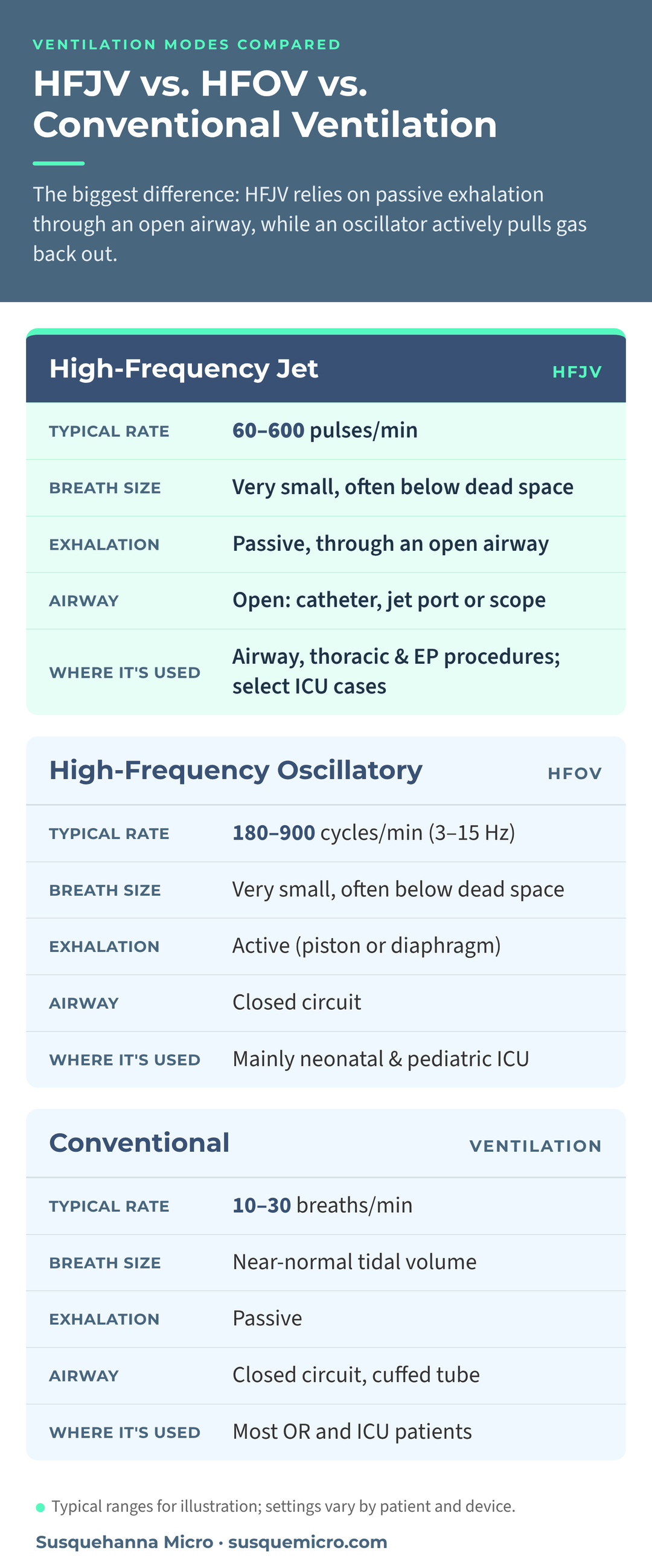
HFJV and high-frequency oscillatory ventilation (HFOV) are often lumped together, but they are different technologies. The biggest difference is exhalation: HFJV relies on passive recoil, while an oscillator actively pulls gas back out.
HFJV can also run alongside a conventional ventilator, adding high-frequency pulses on top of conventional breaths for patients with specific lung problems.
Where is high-frequency jet ventilation used?
HFJV earns its place when it offers something conventional ventilation can't: better surgical access, a stiller field, or gentler pressures in a damaged lung.
ENT and laryngotracheal surgery. In microlaryngoscopy, vocal cord surgery and trachealprocedures, the surgeon and anesthesiologist share the airway. A thin jet catheter replaces a bulky endotracheal tube, giving the surgeon a clear view and more room to work. Jet catheters made from non-flammable materials also reduce fire risk during laser surgery.
Thoracic surgery and bronchoscopy. HFJV supports airway resections, rigid bronchoscopy and one-lung procedures, where small breaths keep the operative lung quieter and limit air leaks.
Electrophysiology and interventional procedures. In the EP lab and cath lab, small, rapid breaths keep the heart and lungs in a more stable position. That helps teams performing cardiac ablation and image-guided procedures where respiratory motion can affect catheter positioning.
Neurosurgery and cardiac surgery. Reduced chest and organ movement can be useful wherever millimeters matter.
Intensive care. For select patients with severe lung injury, ARDS or bronchopleural fistulas,HFJV can maintain gas exchange at lower peak pressures and reduce flow through an air leak.
Risks and limitations to plan for
HFJV is safe in trained hands, but it has failure modes every team should know:
- Air trapping and barotrauma if exhaled gas can't escape, for example from airway obstruction or a misplaced catheter. Continuous pause-pressure monitoring with automatic shut-off is the main safeguard.
- CO₂ buildup during long cases, which is why monitoring and, in some cases,superimposed low-frequency ventilation matter.
- Airway drying without adequate humidification.
- Training and familiarity. HFJV is used less often than conventional ventilation, soprotocols, in-service training and reliable equipment support are part of doing it well.
What to look for in a high-frequency jet ventilator
Whether you're replacing an aging unit or adding jet ventilation to a new procedure room, these are the questions worth asking:
- Is humidification integrated and automatic?
Heated humidification that adjusts to the delivered minute volume removes guesswork and supports longer cases. - How is airway pressure monitored?
Look for continuous pause pressure and peak pressure display, adjustable limits, and an automatic high-pressure cut-off. - Single or double jet?
Decide whether your procedures need superimposed ventilation for longer cases. - Can the controls reach the anesthesiologist?
In a crowded ENT or EP suite, a detachable or remote display makes a real difference. - Does it work with your accessories?
Confirm compatibility with the jet catheters, tubes, laryngoscope adapters and circuits your team already uses. - What are the gas and power requirements?
Check supply pressures for medical air and oxygen against your facility's outlets. - Who services it?
Jet ventilators are specialized. Local, factory-trained service, loaner availability and parts on hand matter as much as the spec sheet.
The Acutronic Monsoon III
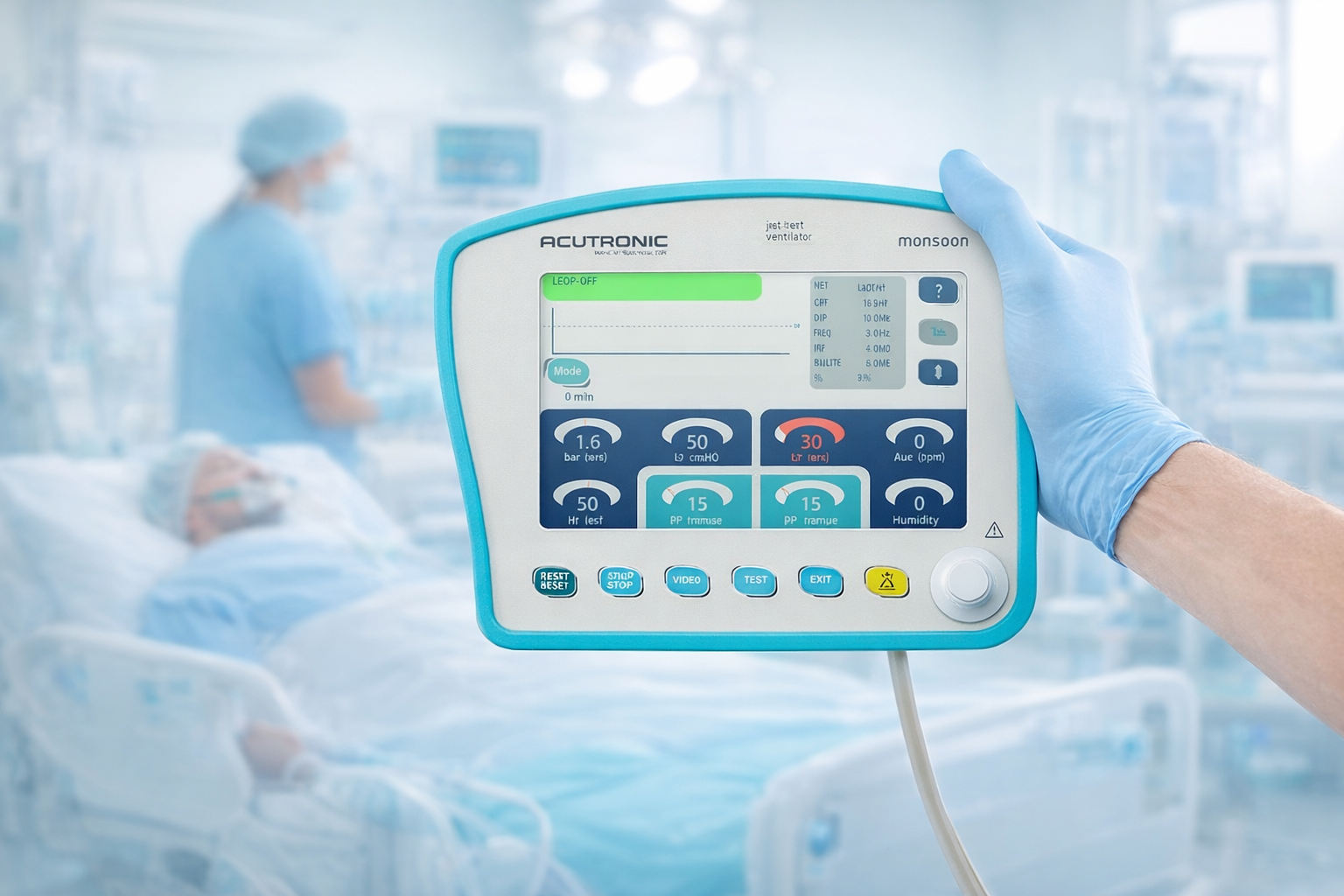
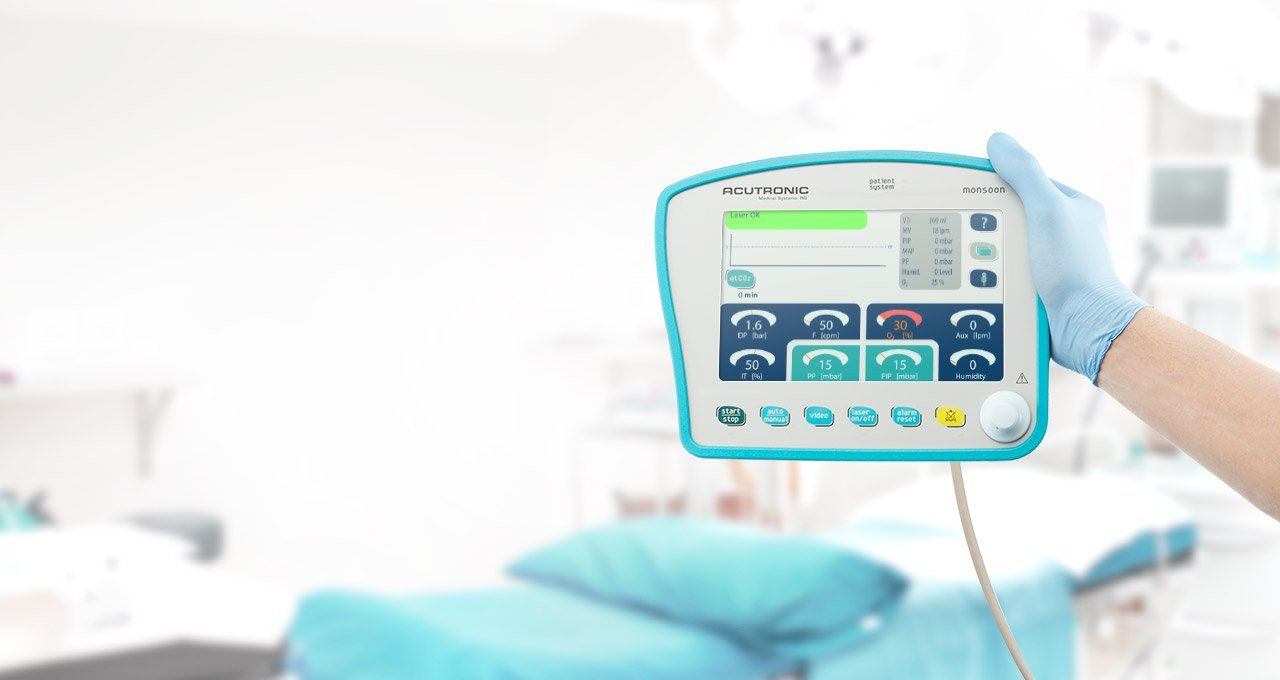
The Acutronic Monsoon III is a universal high-frequency jet ventilator built for ENT, thoracic, cardiac, neurosurgical and EP procedures, as well as intensive care. It replaced Acutronic's Mistral and Monsoon II models. Highlights include:
- Integrated heated humidification that adjusts automatically to the minute volume delivered
- A detachable 9-inch color touchscreen, so the anesthesiologist can work away from acrowded surgical field
- Real-time display of tidal and minute volume, PIP, MAP, end-expiratory and pause pressure
- Pause and peak pressure alarms with an automatic high-pressure cut-off
- FiO from 21 to 100 percent and driving pressure from 5 to 40 PSI₂
- Adjustable bypass flow for pre-oxygenation and auxiliary ventilation
- Compatibility with a conventional ventilator
Susquehanna Micro is an official North American Licensed Dealer for the Monsoon III and stocks
jet ventilation accessories to go with it. For a closer look at the device itself, read
Discovering the Acutronic Monsoon III.
Keeping a jet ventilator ready for the next case
Because jet ventilators are used for scheduled, high-stakes procedures, downtime is costly. A regular preventive maintenance schedule keeps pressure sensors calibrated, alarms verified and humidifier components in good condition. When something does go wrong, a technician who knows the platform can get you back up faster. Susquehanna Micro offers Monsoon III service and repair from its ISO-certified facility in Central Pennsylvania.
Frequently asked questions about HFJV
What is high-frequency jet ventilation used for?
HFJV is used mainly during airway, thoracic, cardiac electrophysiology and other procedures where an open airway or minimal chest movement helps the surgical team. It's also used for select ICU patients with severe lung injury or bronchopleural fistulas.
How fast is high-frequency jet ventilation?
HFJV typically runs at about 60 to 600 pulses per minute, compared with 10 to 30 breaths perminute for conventional ventilation.
What is the difference between HFJV and HFOV?
Both use very small, rapid breaths. HFJV relies on passive exhalation through an open airway, while HFOV uses a piston or diaphragm to actively push and pull gas in a closed circuit.
Does a jet ventilator need humidification?
Yes, for anything beyond short cases. Dry, high-flow jet gas can injure the airway lining, so modern jet ventilators like the Monsoon III integrate heated humidification.
Can a jet ventilator be used with a conventional ventilator?
Some can. The Monsoon III can be used together with a conventional ventilator.
Who services Acutronic jet ventilators in North America?
Susquehanna Micro is an official North American Licensed Dealer for the Acutronic Monsoon III and provides sales, preventive maintenance and repair.
Talk to a jet ventilation specialist
For more than 20 years, Susquehanna Micro has helped hospitals, surgery centers and EMS providers choose, maintain and repair respiratory equipment. Whether you're evaluating HFJV for a new service line or need support for the Monsoon III you already own, our team can help.
Request a quote or call 717-885-0092 (toll free 888-730-5463)
Share this post
Previous Articles